
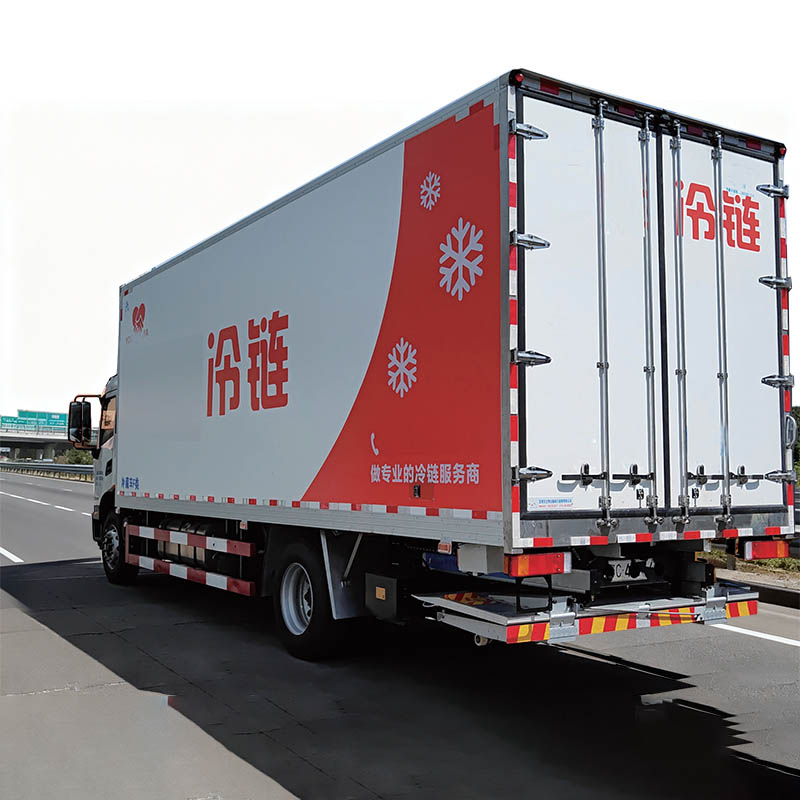
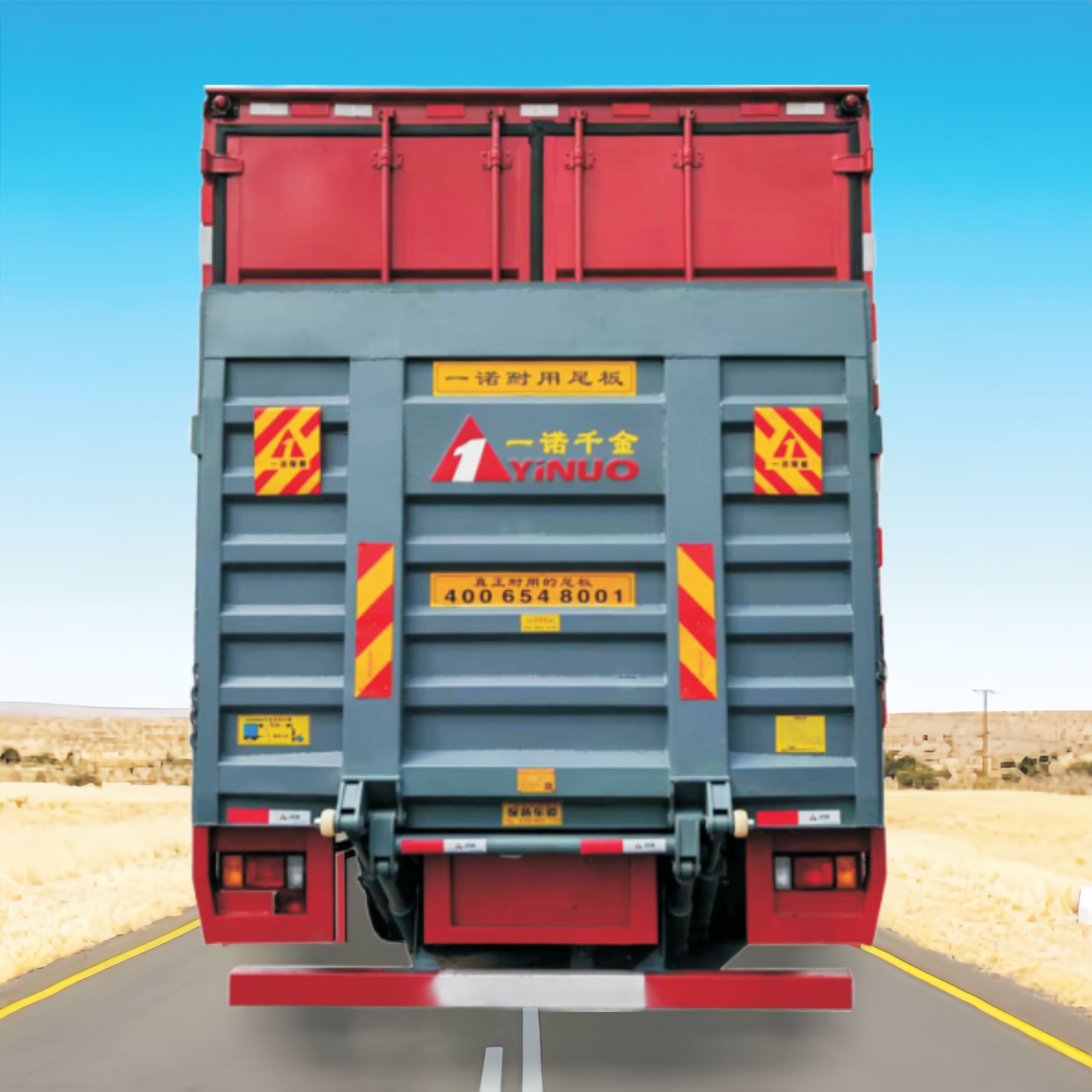

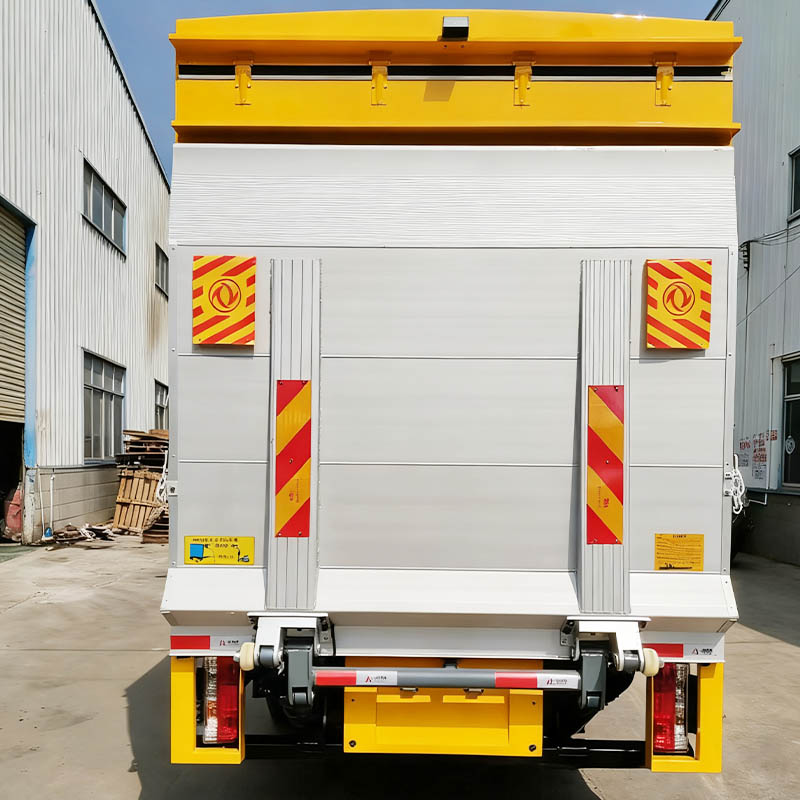


How does a heavy-duty lifting tailgate prevent platform tilting when carrying extra-wide engineering equipment using a hydraulic synchronization system?
Release Time : 2026-02-27
In the field of heavy machinery transportation and large engineering equipment transfer, safety and stability are paramount. When dealing with extra-wide engineering equipment with significantly greater widths and complex center of gravity distributions, a heavy-duty lifting tailgate is not just a simple lifting platform, but a precise mechanical balancing system. If the platform tilts during lifting, it can lead to cargo slippage and damage, or even vehicle rollovers or personal injury. The cornerstone of this safety system is its core hydraulic synchronization system.
1. The Source of the Challenge: The Deadly Threat of Uneven Loading and Deformation
Extra-wide engineering equipment often has a large span and irregular weight distribution. When the equipment is parked on the tailgate platform, it is difficult to ensure that the load on both sides is completely even. This "uneven loading" phenomenon is the main culprit for platform tilting. In traditional asynchronous or low-precision hydraulic systems, the heavier-loaded side will experience increased resistance, resulting in slower descent or lag during ascent, causing the platform to tilt instantaneously.
2. Core Mechanism: Dual Protection of Flow Diversion and Combination with Closed-Loop Feedback
Modern heavy-duty lifting tailgates typically employ a dual protection mechanism of "hardware flow diversion + software feedback." At the basic hardware level, a high-precision flow diversion and combination valve is the first line of defense. Regardless of load distribution, this valve, through its internal precision gear or plate structure, forces the hydraulic pump's output oil to be distributed in a fixed ratio to the left and right master cylinders. This means that even if one side is heavily loaded and the other lightly loaded, the flow rate into the two cylinders is theoretically completely consistent, thus ensuring speed synchronization from the source. However, mechanical flow diversion alone cannot completely eliminate minor errors caused by internal leakage, oil temperature changes, or extreme uneven loading. Therefore, advanced heavy-duty tailgates introduce an electronic closed-loop control system. The system installs highly sensitive displacement or tilt sensors on the left and right sides and rear of the platform to monitor the platform's spatial attitude in real time.
3. Structural Design: A Rigid-Flexible Anti-Torsion Strategy
Besides hydraulic control, optimizing the mechanical structure is also crucial to preventing tilting. For ultra-wide equipment, heavy-duty lifting tailgates typically employ a double-column or even quad-column support structure, coupled with a reinforced box-beam design to maximize the platform's torsional rigidity. The hydraulic cylinder installation positions are precisely calculated, usually using a center-drive or symmetrical dual-drive layout to ensure the thrust line of action passes through the platform's center of gravity, reducing eccentric bending moments. Furthermore, the hinge mechanism connecting the platform to the vehicle is designed with a self-adjusting function. When the hydraulic system operates, the floating bearings at the hinges allow for slight angle self-adaptation, avoiding rigid jamming caused by frame deformation or uneven ground. This "flexible connection" combined with "rigid control" further enhances the system's stability under complex operating conditions.
In summary, heavy-duty lifting tailgates do not simply rely on brute force with thick steel when supporting ultra-wide engineering equipment; instead, they rely on a highly intelligent hydraulic synchronization system. From mechanical forced diversion to electronic real-time correction, and structural torsional optimization, multiple technological safeguards work together to construct a dynamic equilibrium field.
1. The Source of the Challenge: The Deadly Threat of Uneven Loading and Deformation
Extra-wide engineering equipment often has a large span and irregular weight distribution. When the equipment is parked on the tailgate platform, it is difficult to ensure that the load on both sides is completely even. This "uneven loading" phenomenon is the main culprit for platform tilting. In traditional asynchronous or low-precision hydraulic systems, the heavier-loaded side will experience increased resistance, resulting in slower descent or lag during ascent, causing the platform to tilt instantaneously.
2. Core Mechanism: Dual Protection of Flow Diversion and Combination with Closed-Loop Feedback
Modern heavy-duty lifting tailgates typically employ a dual protection mechanism of "hardware flow diversion + software feedback." At the basic hardware level, a high-precision flow diversion and combination valve is the first line of defense. Regardless of load distribution, this valve, through its internal precision gear or plate structure, forces the hydraulic pump's output oil to be distributed in a fixed ratio to the left and right master cylinders. This means that even if one side is heavily loaded and the other lightly loaded, the flow rate into the two cylinders is theoretically completely consistent, thus ensuring speed synchronization from the source. However, mechanical flow diversion alone cannot completely eliminate minor errors caused by internal leakage, oil temperature changes, or extreme uneven loading. Therefore, advanced heavy-duty tailgates introduce an electronic closed-loop control system. The system installs highly sensitive displacement or tilt sensors on the left and right sides and rear of the platform to monitor the platform's spatial attitude in real time.
3. Structural Design: A Rigid-Flexible Anti-Torsion Strategy
Besides hydraulic control, optimizing the mechanical structure is also crucial to preventing tilting. For ultra-wide equipment, heavy-duty lifting tailgates typically employ a double-column or even quad-column support structure, coupled with a reinforced box-beam design to maximize the platform's torsional rigidity. The hydraulic cylinder installation positions are precisely calculated, usually using a center-drive or symmetrical dual-drive layout to ensure the thrust line of action passes through the platform's center of gravity, reducing eccentric bending moments. Furthermore, the hinge mechanism connecting the platform to the vehicle is designed with a self-adjusting function. When the hydraulic system operates, the floating bearings at the hinges allow for slight angle self-adaptation, avoiding rigid jamming caused by frame deformation or uneven ground. This "flexible connection" combined with "rigid control" further enhances the system's stability under complex operating conditions.
In summary, heavy-duty lifting tailgates do not simply rely on brute force with thick steel when supporting ultra-wide engineering equipment; instead, they rely on a highly intelligent hydraulic synchronization system. From mechanical forced diversion to electronic real-time correction, and structural torsional optimization, multiple technological safeguards work together to construct a dynamic equilibrium field.